The Great Wall of China is considered to be one of the most remarkable architectural constructions in the history of humanity. It is a stretch of mountains, deserts, and plains representing centuries of engineering, military tactics, and cultural pride.
This iconic building is located in China, and every year, millions of travelers visit it to walk its ancient stones, visit its watchtowers, and have a view of the world. To most visitors, it is not simply a tourist attraction-it is a trip into ancient civilization.
This full travel guide will assist you in knowing about the history, best places, travel tips, tickets, and all you need to know before visiting the Great Wall.
Where Is the Great Wall of China Located?
The Great Wall is found in northern China, and it cuts across various provinces with mountains, valleys, and desert lands. It was constructed to defend ancient Chinese states against attack by people living to the north.
Beijing, which has several well-preserved sections of the wall, is one of the most popular access points.
Key Geographic Highlights:
- Covering a variety of regions, spans the whole of northern China.
- Crosses mountains, deserts, and grasslands.
- Nearest large tourist centre: Beijing.
- Elevated and rugged terrain can be seen.
The Great Wall, as a man-made wonder, is in itself a natural scenic experience due to its location.
History of the Great Wall of China
The Great Wall of History has a history of over 2,000 years and represents the development of the ancient Chinese civilization.
Ancient Origins
The early walls were constructed in the Warring States era to protect the individual kingdoms. These walls were later consolidated into a continuous defense mechanism by the first emperor of China.
Qin Dynasty Contribution
The Qin Dynasty also saw the start of large-scale building, whereby smaller walls were linked together to create one defensive line.
Ming Dynasty Expansion
The best parts that are in existence today were constructed in the Ming Dynasty. The wall was much reinforced by the use of strong bricks, stone materials, and improved engineering techniques.
Purpose of Construction
- Barrier against the invasions of the North.
- Military defense system
- Domination of trade routes.
- The symbol of oneness and power.
It has become a UNESCO World Heritage site and is a symbol of the ancient Chinese perseverance.
Famous Sections of the Great Wall
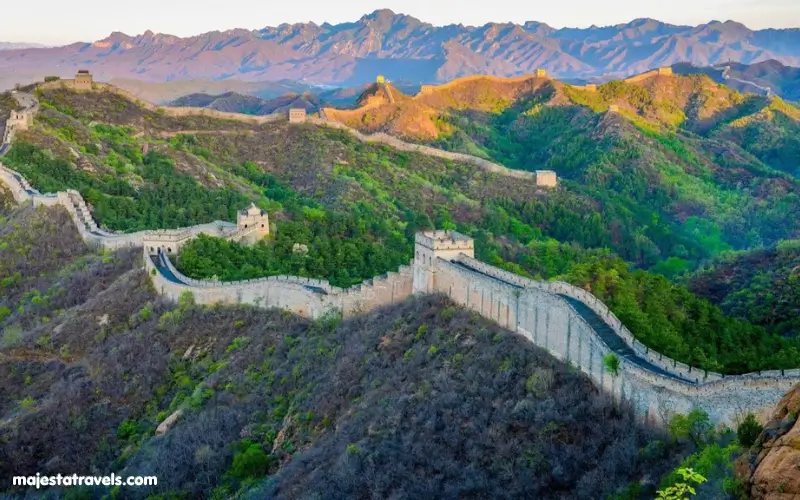
The wall of China is not a continuous one. Rather, it consists of several popular sections, which were created at different times and provide a variety of travel experiences. These areas differ in terms of accessibility, scenery, restoration level, and difficulty, and this enables the travelers to select according to their interests and degree of fitness.
Badaling Section
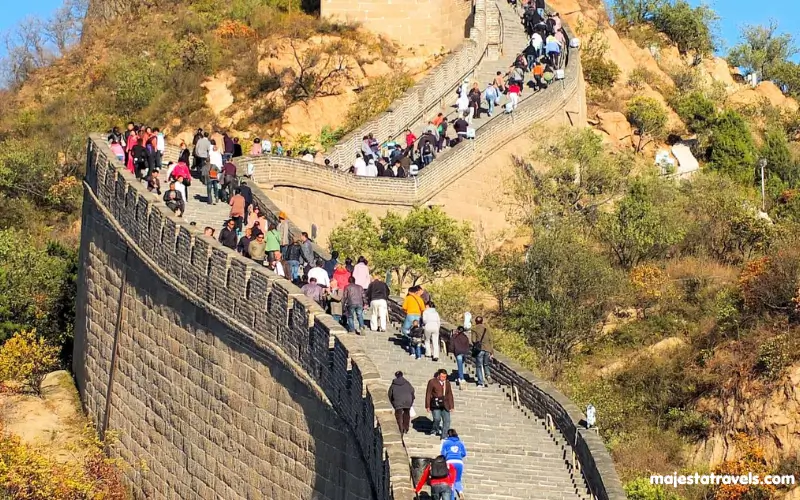
The most popular and most visited part of the Great Wall is the Badaling Great Wall. Most international tourists prefer it as the first option due to the fact that it is highly developed, well-preserved, and very easy to reach for international tourists visiting Beijing.
This part has been very closely preserved, and the walks in it are much safer and more pleasant than those in wilder parts. Large stone walkways, well-marked signs, and robust safety railings allow the suitability of the area to all age groups, including families and elderly visitors.
The first and one of the largest benefits of Badaling is its good infrastructure:
- Direct transport links with Beijing.
- Facilities such as a cable car to provide easy access uphill.
- Restrooms, stores, and visitor amenities.
- Well-maintained walking routes
Due to its proximity and popularity, Badaling may become extremely congested, particularly when it comes to holidays. Nevertheless, it is the most suitable choice for travelers who desire a smooth, organized, and beginner-friendly Great Wall experience.
Mutianyu Section
It is commonly regarded that Mutianyu Great Wall is one of the most beautiful parts of the Great Wall. Dense green forests and rolling mountains surround it, providing a more peaceful and natural outlook than busier tourist locations.
This area does not have as many people as Badaling does and thus is able to provide the visitors with a more relaxed and immersive experience. The landscape here varies with season–green in summer, foliage of every colour in autumn, and foggy landscapes in spring.
Another characteristic that makes Mutianyu visitor-friendly is its visitor-friendly features:
- A cable car to enable easy access to the wall.
- Scenic rides on chairlifts.
- Renowned toboggan ride down experience.
- Repaired walkways appropriately.
This area is particularly attractive to photographers and international travelers since it provides an ideal combination of the beauty of nature and accessibility. The watch towers have some of the most beautiful views on the whole of the Great Wall.
Jinshanling Section
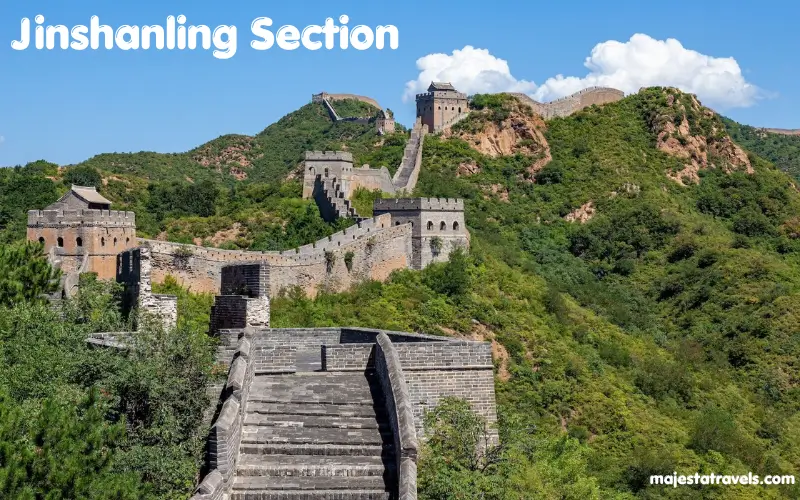
Jinshanling Great Wall is the most suitable section that adventure junkets and hikers will enjoy. In comparison to the more restored regions, Jinshanling still has a semi-wild and authentic look, which allows visitors to have the Great Wall in a more historical and rugged manner.
It is a section characterized by tough hiking trails that climb the mountain ridges. It is best suited to an experienced traveler or someone who seeks a physical adventure because of the steep climbs, uneven stone steps, and long walks.
The main attractions of Jinshanling are:
- Partially restored ancient watchtowers
- Intersectional long-distance hiking trails between sections.
- Spectacular panoramic scenery of mountains and valleys.
- Reduced number of tourists, who provide tranquil exploration.
Due to its crude and less commercialized character, Jinshanling is sometimes regarded as the most authentic Great Wall hiking experience. It is ideal for tourists who wish to visit the wall in its natural historical shape.
Simatai Section
Simatai Great Wall is one of the most unique and dramatic sections of the Great Wall. It has steep climbs, narrow pathways, and its original architecture has been preserved, making it one of the most difficult and yet very rewarding places to explore.
Contrary to most other sections, Simatai has retained much of its ancient military defensive design so that visitors are given a solid idea of what an ancient military defensive design would have looked like. The mountainous area and sharp rises and falls cause spectacular scenery but demand a moderate degree of fitness.
One of the most special features of Simatai is its night tour experience:
- Light-filled night shots of the wall.
- Atmospheric, dramatic mountain lighting.
- Unique photography opportunities
- Uncommon opportunity to view the wall after a sunset.
Simatai is also suitable for tourists looking to have something different compared to the usual tourist paths. It has a blend of adventure, history, and memorable sceneries, and as a result, it is one of the most unique parts of the Great Wall.
How to Visit the Great Wall of China
The Great Wall is mostly visited through the main gateway of Beijing, which is the main entry point to the Great Wall.
Transportation Options:
- Private guided tours
- Public buses from Beijing
- Shuttle services
- Taxi or car rental
Entry Process:
- Purchase tickets either at the entrance or via the Internet.
- Select a section depending on the level of experience.
Best Things to Do at the Great Wall
It is well organized and easy to travel to the Great Wall, and it is appropriate for all types of travelers.
The visit to the Great Wall of China is not only a sightseeing experience but a full travel experience that unites history, adventure, and the beauty of nature. All the activities here assist you in realizing how huge and awe-inspiring this ancient structure is.
Walk on Ancient Stone Paths
The most valuable experience is just to walk on the old stone roads of the Great Wall. When you walk on these bricks, hundreds of years old, you can feel that history is stepping on you.
Initially meant to be used as highways by soldiers to patrol the border, they can now be used by travelers to literally connect with one of the most significant engineering projects in human history. The irregular staircases, meandering paths, and mountain turns demonstrate how developed the ancient Chinese construction was.
It is not merely a physical exercise to walk here but a time travel experience as each step is a reminder of the ancient civilization in China.
Explore Watchtowers
Watchtowers can be considered as one of the most significant elements of the Great Wall. They were employed in ancient times to defend, communicate, and survey the military. The troops would keep an eye on the invasion and would also give smoke signals over long distances.
These towers provide some of the best panoramic views on the wall. Up the mountain, visitors are greeted by seemingly endless mountain ranges, meandering paths of walls, and dramatic landscapes that extend into the horizon.
The visit to these structures provides a better insight into the role of the wall as a full-fledged defense system, rather than as a barrier.
Cable Car Experience
A cable car ride is an ideal choice for travelers who feel comfortable when traveling by a railroad. It enables the visitors to access higher areas of the wall without undergoing the rigorous task of climbing up the steep walls.
When the cable car is riding upwards, you can have a breathtaking aerial view of the surrounding mountains and the wall structure. It is an attitude that emphasizes the huge size of the Great Wall of China and its melodramatic location in rugged terrain.
It is particularly handy with families, older travelers, or any other people who would like to appreciate the landscape without the physical effort.
Photography
One of the most photogenic objects in the world is the Great Wall. It is a photographer’s paradise as it is a combination of ancient architecture and natural landscapes.
Best Photography Moments:
- Sunrise: golden soft light on misty mountains.
- Sunset: warm orange light on the stone walls.
- Noon: good sight of mountain ridges in the distance.
Each of the angles provides a distinct atmosphere, such as serene, dramatic, and strong. Regardless of whether you are working with a professional camera or a smartphone, the shots always look beautiful.
Hiking Adventures
Hiking, to adventure lovers, is one of the most beneficial modes of experiencing the Great Wall. There are areas where one is able to do long-distance trekking over mountain ridges, rough trails, and wild areas.
Hiking in this area is not only physically demanding, but also very rewarding. You go through old watchtowers, pieces of the wall, and untouched landscapes that present the wall in its most natural condition.
Mutianyu, Jinshanling and Simatai are popular hiking areas, with each offering a different level of difficulty and scenery.
It is not only a workout but a great discovery of history, nature, and human accomplishment in China.
Best Time to Visit the Great Wall of China
The optimum time to visit the Great Wall of China will be determined by the weather, sightseeing, and the number of people. The Chinese seasons provide a different travel experience, and it could be a colorful landscape or a view of snowy mountains.
When it is appropriate can make your trip more comfortable,e and you will be able to see even better photography, hiking, and sightseeing.
Spring (March–May)
One of the best seasons to visit the Great Wall is spring because it is the most pleasant season of the year.
- Comfortable and mild weather
- Blossoms of flowers in the mountains.
- White skies and gentle sunshine.
- Ideal places to walk and hike.
In spring, the nearby sceneries turn to be green and fresh, making it the best time to take photographs and have an outdoor adventure. It is an excellent period of the year since travelers who dislike weather extremes and the beauty of nature will enjoy the season.
Autumn (September–November)
Autumn has often been regarded as the most appropriate season to visit the Great Wall.
- Optimal weather to travel and hike.
- Colors of mountains: golden and red.
- Good visibility for photographing.
- Moderate temperatures during the day.
During this season, the woodlands surrounding the wall become a riot of orange, yellow, and red. It is one of the most aesthetical periods of the year to visit due to the combination of ancient stone walls and colorful nature.
Summer (June–August)
The busy season of tourism in China is summer.
- The green scenery all around.
- Extended daylight exploration.
- Very crowded tourist areas
- Hot and sometimes humid weather
Although the summer is a beautiful season with green scenery, it may be physically exhausting with the heat and humidity. It is advisable to visit early in the morning to avoid peak temperatures and overcrowding.
Winter (December–February)
Winter is an entirely different and serene experience.
- The Great Wall scenery is covered with snow.
- Very few tourists
- Cold and crisp mountain air
- Unobtrusive and serene environment.
The snow turns the Great Wall into a white magic scenario. Even though it can be extremely cold, it is the best season when people can have their own time, get some unusual photos,s and have a calm and relaxing vacation without crowds of other people.
Great Wall Hiking Experience
The Great Wall of China hiking is one of the most engaging and satisfying traveling experiences in the world. Contrary to a mere sightseeing tour, hiking enables the traveler to associate him/herself with history by using their legs to discover ancient stone tracks, watch towers, and mountain ranges throughout China.
Every inch on the wall shows how much ancient engineers worked, how many workers worked, and how strategic this masterpiece of ancient times is.
Difficulty Levels of Great Wall Hiking
The various parts of the Great Wall provide varying hiking difficulty and are thus suitable for both beginners and experienced trekkers.
Easy Level: Badaling
The most convenient and accessible hiking part is the Badaling Great Wall.
- Well-maintained and smooth walking tracks.
- Obvious steps with safety railings.
- Easy hiking trails on offer.
- Good with families and on their first hike.
It is a suitable section to explore by those who are interested in a light walking experience without any physical challenge, yet still have the iconic views of the Great Wall.
Moderate Level: Mutianyu
Mutianyu Great Wall is a moderate hiking experience.
- Moderately steep yet in good condition tracks.
- Surrounded by forests and mountains
- Not so congested as Badaling.
- The following are cable cars and chairlift possibilities.
This area is ideal for travelers who may desire a combination of comfort and adventure. It offers great scenic vistas and is not very physically exerting.
Challenging Level: Jinshanling & Simatai
The most difficult hiking places are Jinshanling Great Wall and Simatai Great Wall.
- Sharp ascents and irregular steps of stones.
- Long-distance hiking routes
- Semi-wild and unrestored areas.
- Requires a good fitness level
These sections are ideal for experienced hikers and adventure travelers who want a more authentic and rugged Great Wall experience. The mountain ridge views are among the most dramatic in the whole building.
What to Carry for Great Wall Hiking
To have a safe and enjoyable hiking trip on the Great Wall, proper preparation is needed.
Comfortable Shoes
Wear strong walking or hiking shoes that have a good grip because the paths of the stones may be steep and uneven.
Water Bottle
Always carry with you ample water to keep you hydrated during the summer months when temperatures may be high.
Sun Protection
Wear a hat, sunscreen, and sunglasses to cover yourself against direct sunlight, as most areas have little cover.
Light Backpack
A small backpack would be perfect to carry the essentials such as snacks, water, camera without adding any extra weight.
Photography Guide
The Great Wall is considered to be one of the most photographed landmarks in the world.
Best Photography Spots:
- Mountain ridges
- Watchtowers
- Curved wall sections
Best Times:
- Sunrise to use soft light.
- Golden views of sunset.
- Winter, when the snow covers the landscape.
- Nature and history combined make each photo a film.
Travel Tips for Visitors
- Go early in the morning to escape the crowds.
- Wear comfy walking shoes.
- Reserve tickets in advance when the season is at its peak.
- Bring water and food.
- Select the appropriate section depending on the level of fitness.
- Get a guide to give some historical points.
Is the Great Wall of China Worth Visiting?
Yes—absolutely.
For History Lovers
A first-hand linkage to ancient Chinese civilization.
For Adventure Travelers
Vitalizing hiking trails through the mountains.
For Photographers
The world has one of the most striking landmarks that is pleasing to the eye.
For Families
Educational and enjoyable travelling experience.
Nearby Attractions in Beijing
While visiting the Great Wall from Beijing, you can also explore:
- Forbidden City
- Temple of Heaven
- Summer Palace
- Local cultural markets
These sites will make your trip to China complete.
Conclusion
The Great Wall of China is more than a monument; it is a history, a symbol of strength, and a symbol of human achievement. Granted that you might read its restored areas, or walk its wild trails, each step is a tale of old times.
This is a once-in-a-lifetime experience that combines culture, adventure, and breathtaking scenery.
FAQs
1. What is the Great Wall of China famous for?
The Great Wall of China is known to be among the largest and most remarkable ancient defense constructions ever made. This was created to defend ancient Chinese states against intrusion and now acts as a symbol of power, history, and engineering quality.
2. Where is the Great Wall of China located?
The Great Wall is situated in the northern part of China and cuts across mountains, deserts, rivers, and plains. Most of the tourist access points ine to the vicinity of Beijing, where there are various well-preserved sections that visitors can visit.
3. Can you walk on the Great Wall of China?
Yes, the visitors are allowed to walk on some restored openings of the Great Wall. Popular walking routes are Badaling, Mutianyu, Jinshanling, and Simatai, with varying degrees of difficulty and scenery.
4. What is the best section of the Great Wall to visit?
The most appropriate section will be based on your style of traveling:
- Badaling: It is the easiest to find and to use.
- Mutianyu: It is the best with scenic views and fewer crowds.
- Jinshanling: Hiking and adventure.
- Simatai: Most suitable for rough and dramatic experiences.
5. How long does it take to visit the Great Wall?
The average visit lasts:
- A short tour will take 2-3 hours.
- One section to explore will take half a day.
- Whole day hiking and photography.
The time taken in traveling also varies depending on the section one takes and the distance between the chosen section and Beijing.
6. What is the best time to visit the Great Wall of China?
Before the weather becomes hot, the best season to visit is spring (March- May) and autumn (September- November), when the weather is pleasant, and the scenery is in its best condition. Autumn is particularly a favorite photography season with colorful mountain scenery.
7. Is the Great Wall visible from space?
No, the Great Wall cannot be easily seen with the naked eye using a high-resolution telescope in space. It is a popular myth. Although it is very long, its width and color are merged into the natural scene.
8. How difficult is hiking the Great Wall?
The difficulty of hiking depends on the section:
- Easy: Badaling
- Moderate: Mutianyu
- Difficult: Jinshanling and Simatai
Based on fitness level and experience, the travelers can make a choice.
9. Do you need tickets to visit the Great Wall?
Yes, in most of the sections an entry ticket is needed. The prices will be different with respect to the place and other facilities, like the cable cars or the shuttle facilities. There is generally an option of buying a ticket either at the location or online.
10. Why should tourists visit the Great Wall of China?
The Great Wall attracts tourists as it is able to provide a set of values like history, architecture, hiking adventure, and spectacular views of the mountains. It is a landmark which, among others, is considered to be one of the most iconic landmarks in the world and a must-see site in China.